Stop vibing, start engineering.
Structured learning to close your gaps
so you can actually build the desired projects and grow as an engineer
No coding exercises or "build your portfolio website".
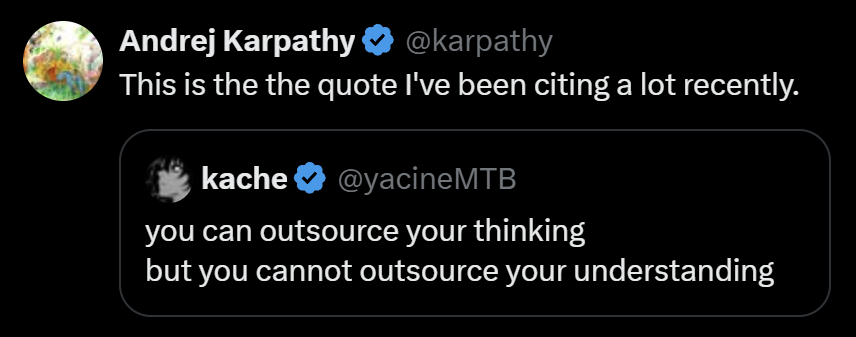
Source: Andrej Karpathy (x.com)
Structured learning to close your gaps
so you can actually build the desired projects and grow as an engineer
No coding exercises or "build your portfolio website".
Source: Andrej Karpathy (x.com)
the world changed
you shipped it, but couldn't explain it
AI wrote the code, the feature works, and you moved on. The next day prod is down because there were no proper DB indexes. Will you really blame your AI agent?
prompting isn't the same as growing
You can get a working feature out today. But when it breaks at 2am, or an interviewer asks you to walk through it, the AI isn't in the room, and neither is your answer.
courses and docs, but nothing sticks
You've bookmarked the docs, maybe started a course. By the time you finish, best practice already moved on, and none of it was really about your code anyway.
the loop
Our product reads your real history: GitHub, stated experience, stack. You can upload your materials: college lectures, video courses, repos. Then it researches a roadmap suited to where you actually are.
Instead of handing you the answer, the AI asks what a senior engineer would ask, pushing you to reason about trade-offs, not just recall syntax.
Coding and design tasks get reviewed on architecture, security, and maintainability - not just whether the tests pass.
Completed lessons, mistakes, strengths persist. When a topic goes stale, mentor resurfaces it before you forget it under pressure.
Build my plantry it
Type what you want to get good at. Add your GitHub and onboarding reads your actual stack - the languages you ship in, and the gaps you don't know you have.
~2 minutes · Nothing saved · no account needed
Or start from one of these
Public repos only. We read which languages you ship in and how recently — never your code. No sign-in, nothing stored.
not another course. not a chatbot.
You can talk through trade-offs with real depth, because you actually reasoned through them — not because you memorized an answer.
Real design reviews and code reviews you can point to, not a certificate nobody asks to see.
When the ticket says "just make it scale" you already have the plan — not a prompt.
Your progress persists. Year two builds on year one instead of starting over from a skill quiz.
before you ask
A chat answers what you ask. It cannot tell you what you should learn next. Here your plan comes from your GitHub and your own files. You get lessons, quizzes and real coding tasks. Big tasks go to a GitHub repo, where an agent reviews your pull request like a senior engineer. Everything you finish is saved and tested again later.
Slop is content written for everyone and checked by no one. Your lessons come from your experience, your stack and the files you upload. Each topic is researched fresh, not copied from a fixed course. Then you are tested: can you actually use it? Your code is reviewed for architecture, security and clean design. If a test finds a gap, you get more material on that gap.
You can copy code. You cannot copy the reason behind it. The mentor asks why you chose what you chose. Old topics come back weeks later. Reviews look at your decisions, not just at code that runs.
Any stack the AI can work with, which is almost all of them. Nothing is written in advance, so there is no fixed list of supported topics. You will get the most from backend and architecture: databases, caching, queues, APIs, system design. Frontend, mobile and data work too. Backend is simply where it is strongest.
It is made first for engineers who already ship code. But juniors are welcome, because the plan starts from where you really are. It reads your real history, not a quiz. If you use Postgres every day, no one explains what a primary key is. You get asked why your index is not used.
Yes. Upload lecture slides, a PDF, a video course, your notes or a repo. Your plan can be built fully or partly from them. The rest is researched to fill the gaps.
A course puts you back at lesson one and never notices that you left. Here your lessons, mistakes and weak spots are saved, and the plan changes with them. When you start to forget a topic, the mentor brings it back.
No. Skip it and answer a few questions instead. If you use it, we read only public data — no OAuth, no private repos, no write access. It only makes your plan personal. If you join the waitlist, we save your username with your email. If you do not, we only count it anonymously.
Tell what you're chasing — the plan, built from your actual experience, starts now.